What is the ROI of installing commercial solar parking lot lights? For property owners, the answer depends on more than the panel price. A realistic assessment compares installation costs, electricity savings, maintenance, lighting performance, and battery replacement. It also considers local sunlight, parking hours, utility rates, and available incentives. A lot in Phoenix will not perform like one in Seattle. That difference matters.
Abigail Ross Hopper, president and chief executive officer of the Solar Energy Industries Association, said, “Solar is no longer an alternative energy source. It is the energy source.” Her statement reflects solar’s expanding commercial role, but parking lot lighting requires careful financial judgment. Solar fixtures can reduce trenching, wiring, and monthly electricity bills. They may also protect owners from rising grid prices. However, batteries can weaken over time, and shaded locations may reduce nighttime performance. The numbers are not always perfect.
A credible ROI review should begin with a site survey. Measure pole spacing, nighttime usage, winter sun exposure, and required illumination levels. Then compare the solar system’s total lifetime cost with conventional grid-connected lighting. Include cleaning, inspections, battery replacement, and potential downtime. A simple payback estimate can be useful, but it may hide long-term risks. Net present value and lifecycle cost offer a clearer picture.
This guide explores the financial and operational factors behind commercial solar parking lot lights. It focuses on measurable savings, practical limitations, and decisions that facility managers can defend. The goal is not to promise instant returns. It is to show where solar lighting works well, where assumptions fail, and how careful planning can improve investment confidence.
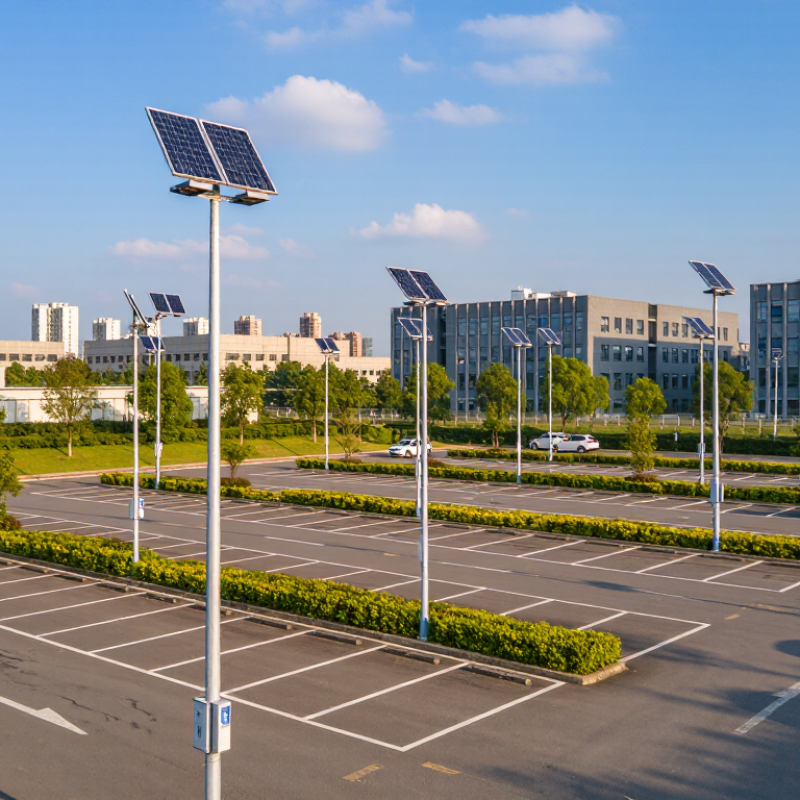
Commercial solar parking lot lights are outdoor lighting systems designed for business properties, including retail centers, offices, warehouses, and medical facilities. Each unit typically combines a solar panel, rechargeable battery, LED fixture, controller, and mounting pole. During daylight, the panel converts sunlight into electricity and stores it in the battery. After sunset, the LED light uses that stored energy to illuminate parking spaces, driving lanes, walkways, and entrances.
Unlike grid-connected lights, these systems can operate without underground power cables or monthly electricity consumption. That difference often supports a stronger return on investment. Property owners may reduce trenching costs, electrical installation work, energy bills, and maintenance visits. Motion sensors and programmable controls can lower battery demand when parking areas are quiet. However, performance depends on local sunlight, panel direction, weather, shade, and lighting requirements.
Not every installation delivers the same savings. A shaded lot can charge batteries poorly, especially during winter. Battery replacement also affects long-term operating costs. A practical design should measure nighttime lighting levels, estimate seasonal solar production, and review expected maintenance before installation. This step is sometimes rushed. It should not be. A well-designed system can provide dependable illumination for years, while an oversized or poorly positioned system may waste money despite impressive specifications.
Commercial solar parking lot lights generate value by replacing grid electricity with sunlight collected on site. During the day, photovoltaic panels charge a battery, which powers LED fixtures after sunset. This reduces trenching, wiring, utility connections, and monthly energy charges. For a large parking area, avoiding underground electrical work can significantly improve project economics. The savings become visible near each pole.
Their value also comes from controlled lighting performance. Modern LED fixtures can deliver focused illumination across drive lanes, pedestrian routes, and parking spaces. Motion sensors or dimming schedules may reduce battery demand during quiet hours. In practice, a well-designed system considers pole spacing, tree growth, winter sunlight, and local weather records. A cloudy week can expose weak planning quickly.
Maintenance savings matter too. Independent solar poles can continue operating when grid power fails, improving site access and security. Technicians can inspect battery health, panel cleanliness, and fixture output remotely or during scheduled visits. Still, solar lighting is not automatic or risk-free. Batteries eventually lose capacity, and shaded panels can reduce nighttime runtime. A reliable return on investment depends on accurate load calculations, durable components, proper installation, and realistic replacement planning. The cheapest quotation may become expensive later. That deserves honest review.
The return on investment for commercial solar parking lot lights depends on more than the panel price. A realistic calculation includes fixtures, poles, foundations, wiring, installation, permits, and site preparation. Remote lots may require extra equipment or lifting access. Those costs can raise the initial investment quickly.
Electricity savings usually create the main financial return. Solar lights avoid trenching, utility connection fees, and monthly power charges. However, battery replacement can change the picture. Battery life depends on temperature, charging cycles, lighting schedules, and system quality. A weak battery may reduce nighttime brightness before its expected service period ends. Solar panels also need occasional cleaning, especially near dusty roads or construction areas. Maintenance is limited, not absent.
My first estimate was too optimistic because it ignored ground conditions. Rocky soil increased foundation work, while nearby trees reduced sunlight during winter. Motion controls may lower energy use, but they can frustrate drivers if the lights activate slowly. Local rebates, electricity rates, and operating hours also affect the payback period. A reliable ROI model should compare ten-year costs, expected replacements, maintenance labor, and avoided utility expenses. It should also include a modest reserve for vandalism, storm damage, or underperforming components. Real projects rarely match the spreadsheet perfectly. That gap deserves attention.
Why Is the ROI of Commercial Solar Parking Lot Lights?
Commercial solar parking lot lights can reduce two major expenses: electricity and underground wiring. Each fixture uses a photovoltaic panel to charge a battery during daylight. At night, efficient LEDs illuminate parking spaces, walkways, and loading areas.
The financial return depends on local sunlight, lighting schedules, and installation conditions. A site needing long cable runs may save more with solar fixtures. Avoided trenching can reduce labor, pavement repairs, and permitting costs. Monthly electricity bills may also decline because the lights operate independently from the grid. However, the calculation is not always flattering. Battery replacement and occasional panel cleaning must be included in the budget.
Operational benefits often appear before the full payback period. Installation can disturb less pavement, which helps businesses keep parking areas open. Independent lighting can also continue operating during some grid interruptions. That matters near entrances, employee walkways, and delivery zones. Better visibility may support safer vehicle movement and more confident after-hours operations. Field experience shows that light placement matters as much as wattage. A poorly positioned fixture can create dark patches, even with a strong panel. Managers should review nighttime coverage, battery performance, maintenance records, and seasonal sunlight before approving a project. Small oversights remain expensive.
This representative 10-year model assumes 100 parking lot fixtures. Solar lighting requires a higher initial investment, but it eliminates grid electricity costs and reduces maintenance exposure. Under these assumptions, the solar system produces approximately $25,700 in net savings over ten years, with an estimated 28.6% return on the additional solar investment and a payback period of about 6.6 years. Actual results vary according to local electricity prices, site conditions, fixture specifications, and battery replacement cycles.
Commercial solar parking lot lighting ROI begins with a fair baseline.
Record each existing fixture’s wattage, operating hours, electricity rate, and maintenance history.
The U.S. Department of Energy reports that LEDs use at least 75% less energy than incandescent lighting and can last up to 25 times longer. However, solar fixtures also require battery replacement and periodic panel cleaning.
Build a five- to ten-year cash-flow model. Include equipment, installation, trenching, permits, battery replacements, inspections, and avoided utility costs.
The U.S. Energy Information Administration’s Electric Power Monthly provides commercial electricity prices for regional calculations.
For example, 40 grid-connected fixtures operating 12 hours nightly may create substantial annual savings when compared with solar units. Yet, actual returns depend on local sunlight, winter weather, shading, and lighting controls.
Measure more than payback.
Compare lifecycle cost, nighttime illumination, outage performance, and maintenance labor.
IES RP-8 offers guidance for roadway and parking-area lighting levels, helping businesses avoid under-lit spaces.
A simple formula works: ROI equals net savings divided by total investment.
But that estimate can be wrong. Overly optimistic battery life, weak winter output, or poor pole placement can distort results.
A pilot installation with measured light levels and runtime data is often more reliable than a spreadsheet alone.
Reference sources: U.S. Department of Energy, Solid-State Lighting; U.S. Energy Information Administration, Electric Power Monthly; Illuminating Engineering Society, RP-8.
They are outdoor lighting systems for parking spaces, driveways, walkways, and entrances. Each unit usually includes a solar panel, battery, LED fixture, controller, and pole.
The panel collects sunlight during the day and charges a rechargeable battery. After sunset, stored energy powers the LED fixture. Simple.
Retail centers, offices, warehouses, medical facilities, and other business properties can use them. They work best where grid connections are expensive or unavailable.
They may reduce trenching, electrical installation, utility fees, and monthly electricity charges. Maintenance still exists. Batteries need eventual replacement, and dusty panels need cleaning.
Initial costs include fixtures, poles, foundations, permits, installation, and site preparation. Electricity rates, operating hours, maintenance, and battery replacements also affect payback.
Yes. Panel direction, seasonal sunlight, weather, and nearby shade affect battery charging. Trees can block winter sunlight. A shaded lot may produce weaker nighttime lighting.
Motion sensors can reduce battery demand when the lot is quiet. However, slow activation may frustrate drivers or pedestrians. Testing matters.
It should measure nighttime lighting levels and estimate seasonal solar production. The assessment should review soil, shade, maintenance access, and replacement costs.
Yes. My earlier estimate ignored rocky soil and winter shade from nearby trees. Actual costs may exceed the spreadsheet. A reserve for repairs is sensible.
Commercial solar parking lot lights are outdoor lighting systems that combine solar panels, batteries, LED fixtures, and smart controls to illuminate parking areas without relying entirely on grid electricity. During the day, the panels convert sunlight into power and store it for nighttime use. Their value comes from reducing electricity consumption, limiting trenching and wiring requirements, and providing dependable lighting in areas where grid connections may be expensive or difficult. However, the return on investment depends on equipment costs, installation, battery replacement, maintenance, site conditions, energy prices, and available incentives.
To determine what is the ROI of installing commercial solar parking lot lights, businesses should compare the initial investment with long-term savings and operational gains. These may include lower utility bills, reduced maintenance visits, improved energy efficiency, greater lighting independence, and enhanced visibility for customers and employees. A practical evaluation should estimate annual savings, expected system life, replacement costs, and payback time under realistic sunlight and usage conditions. By reviewing both financial and operational benefits, businesses can decide whether solar parking lot lighting supports their budget and sustainability goals.
